Personal Loans
Online Payday Loans in California
Compare lenders and learn about California payday loan laws, borrowing limits, fees, and repayment rules.

OnlineLoans.org is a comparison marketplace, not a lender. We may earn compensation from partners featured on this site, which can affect placement. Editorial content is informational and is not financial, legal, or professional advice.
- At a glance
- California payday loan laws & limits
- Best payday loan providers
- California payday loan calculator
- Are payday loans legal?
- How payday loans work
- Can you get one online?
- Maximum loan amount
- How much does it cost?
- How to verify a lender?
- What you need to apply?
- Do lenders check credit?
- Payday loans with bad credit?
- How fast is funding?
- How many loans allowed?
- Can you roll over a loan?
- If you can't repay?
- Do they affect credit?
- Can lenders sue you?
- Can lenders garnish wages?
- Payday loan alternatives
- Lender reviews
- How we rate providers
- Conclusion
- Sources
California payday loans at a glance
California payday loan laws & limits
Source: California DFPI| California payday loan rule | Current limit |
|---|---|
| Maximum check amount | $300 |
| Maximum cash received | $255 |
| Maximum finance fee | $45 |
| Maximum fee percentage | 15% |
| Maximum term | 31 days |
| Multiple outstanding payday loans | Not permitted |
| Rollovers | Not permitted |
| Returned check fee | Up to $15 |
| Regulator | California DFPI |
| Last verified | August 2026 |
Best payday loan providers in California
Licensed by California DFPI. Fees shown are state maximums; funding timing may vary.| Lender | Expert Rating | Receive | Fee | Return | Period | Learn More |
|---|---|---|---|---|---|---|
 | $255 | $45 | $300 | 14-31 days | SEE LOAN OPTIONSBy Check City with onlineLoans.org | |
 | $255 | $45 | $300 | 14-31 days | SEE LOAN OPTIONSBy Advance with onlineLoans.org | |
 | $200 | $35.28 | $235.28 | 14-31 days | SEE LOAN OPTIONSBy ACE with onlineLoans.org | |
 | $255 | $45 | $300 | 14-31 days | SEE LOAN OPTIONSBy Check&Go with onlineLoans.org | |
 | $255 | $45 | $300 | 14-31 days | SEE LOAN OPTIONSBy Speedy with onlineLoans.org | |
 | $200 | $35.29 | $235.29 | 14-31 days | SEE LOAN OPTIONSBy Moneytree with onlineLoans.org |
How we rate payday loan providers →
California payday loan calculator
Max fee estimate · Verified with DFPI · Aug 2026Are payday loans legal in California?
Payday loans are legal in California, but lenders must follow the California Deferred Deposit Transaction Law and be licensed by the California Department of Financial Protection and Innovation (DFPI).
California limits the total payday loan transaction to $300, including the lender's fee. The loan term cannot exceed 31 days, and lenders must follow state limits on fees, multiple loans, rollovers, and returned payments.
How do payday loans work in California?
A California payday loan is a short-term loan that is generally repaid on your next payday. You provide the lender with a check or electronic debit authorization for the total amount you will repay, and the lender gives you the cash amount minus its fee.
For example, with the maximum $300 transaction, a lender can charge up to a $45 fee, leaving you with $255 in cash. You would then repay $300 on the agreed due date, which cannot be more than 31 days later.
Can you get a payday loan online in California?
Yes. Payday loans can be offered online to California residents, but an online payday lender must be licensed by the California DFPI to legally make payday loans in the state.
Before providing personal, banking, or income information, check the lender in the DFPI license database. A website accepting applications from California residents is not automatically a licensed California lender.
What is the maximum payday loan amount in California?
California limits the total payday loan transaction to $300, including the lender's fee. Because the maximum lender fee is $45, the most cash you can receive is generally $255 when the maximum fee is charged.
In simple terms: you receive $255, the fee is $45, and you repay $300.
How much does a payday loan cost in California?
California payday lenders can charge up to 15% of the face amount of the check or debit authorization.
On the maximum $300 transaction, that means a maximum fee of $45. You receive $255 in cash and repay $300. Smaller loans have proportionally smaller maximum fees. Use the California payday loan calculator on this page to estimate the fee for a specific cash amount.
How to verify a payday lender in California?
Search the California DFPI license database before you apply. Use the DFPI license search to confirm the company is an active deferred deposit originator—the legal term for payday lenders in California. Also check whether the DFPI has published enforcement actions against the company.
A website offering loans to California residents is not automatically licensed. Unlicensed online lenders may charge fees that do not comply with state law.
What do you need to apply for a payday loan in California?
Typically, you'll need proof of identity, a source of income, an active bank account, and basic contact information. Exact eligibility requirements vary by lender, so approval is not guaranteed even if you provide these items.
California law separately limits the total check amount for a payday loan to $300, including the lender's fee.
Do payday lenders check your credit in California?
They may. California does not require every payday lender to use the same credit-check process, so the type of review depends on the lender.
Some lenders may review information from traditional or alternative credit reporting sources, while others may put more emphasis on your income, bank account, identity, and ability to repay. Do not assume that "bad credit accepted" means there will be no credit or financial-history check.
Can you get a payday loan with bad credit in California?
Possibly. Payday lenders may use different underwriting standards than banks and traditional personal loan lenders, so a low credit score does not automatically mean your application will be denied.
However, approval is never guaranteed. The lender may consider your income, bank account activity, existing obligations, credit or alternative consumer reports, and other information when deciding whether to approve the application.
How fast can you get an online payday loan in California?
Funding speed depends on the lender, when you apply, the funding method, and your bank. Some licensed lenders offer same-day or instant funding options for eligible borrowers, while standard bank transfers may arrive on the same or next business day.
Fast funding is not guaranteed, so borrowers should check the lender's actual funding terms before applying.
How many payday loans can you have in California?
California law prevents a payday lender from making another payday loan to you while an earlier loan from that lender is still outstanding. A lender also cannot use a new payday loan to pay off an existing payday loan. California does not currently operate the statewide payday-loan database that had previously been proposed to enforce a one-loan limit across all lenders.
Can you roll over a payday loan in California?
No. California does not allow payday lenders to roll over or refinance a payday loan by issuing another payday loan to pay off the existing one.
If you cannot repay on time, you can ask the lender for an extension or payment plan. The lender is not required to approve the request, but if it grants an extension, California law does not allow it to charge an additional fee for that extension.
What happens if you can't repay a payday loan in California?
Contact the lender before the due date and ask for an extension or payment plan. California law does not require approval, but a lender cannot charge an extra fee if it grants an extension.
If your payment is returned, the lender may charge one fee of up to $15. A lender cannot issue a new payday loan to pay off an existing one, and nonpayment is not a criminal offense.
Do payday loans affect your credit score?
It depends on the lender and what happens with the loan. Payday lenders do not all use or report to credit bureaus in the same way.
A credit inquiry may affect your credit depending on the type of inquiry, and information reported to a consumer reporting agency could affect your credit history. If an unpaid loan is sent to collections or results in other collection activity, there may also be additional financial consequences.
Can a payday lender sue you in California?
Yes, potentially. An unpaid payday loan is a civil debt, and a lender may use lawful collection methods, including pursuing a court judgment.
However, a California payday lender cannot threaten to prosecute you in criminal court simply because your check is returned for insufficient funds.
Can payday lenders garnish your wages in California?
Yes, but not automatically. A payday lender generally must first obtain a court judgment and follow California's wage-garnishment process before money can be withheld from your paycheck.
Wage garnishment is subject to legal limits, and borrowers may be able to claim exemptions in certain circumstances.
What are alternatives to payday loans in California?
Before using a payday loan, consider whether a less expensive option is available. Depending on your situation, alternatives may include asking a creditor for more time to pay, requesting a paycheck advance from your employer, checking short-term loan options from a bank or credit union, or borrowing from family or friends.
Compare the total dollar cost and repayment terms before choosing an option. A payday loan can provide short-term cash, but its cost is high relative to the amount borrowed.
Lender reviews
Check City is a direct payday lender that operates online in California (and has physical stores in a few other states like Nevada and Utah). In California, Check City is online-only, but it is a fully licensed lender in the state. They are known for a fast application process and good customer service, and they tout an "Excellent" Trustpilot rating from their customers.
Loan amounts & terms:
Maximum $255 cash per loan in California (which results in a $300 check including the fee). The loan term will be until your next payday (up to 31 days). Check City allows you to borrow any amount up to the max, in increments (for example, you could borrow just $100 or $200, not necessarily the full $255, depending on your need and approval). As with others, you'll owe the full amount plus fee on your due date.
Fees:
Check City charges the standard 15% fee of the check amount. Borrow $255 and you'll pay $45 in fees. Their site is transparent about rates – for California, they clearly state the cost per $100 and give examples. That works out to the same ~460% APR for a 2-week loan as other lenders. There are no additional fees beyond this finance charge (no application fee, no prepayment fee – you can repay early to save interest, though on a short loan the fee is typically fixed).
Eligibility requirements:
You must be 18+ and a resident of California with valid identification. A steady income is required (employment or other income sources) and an active checking account that accepts ACH transfers. You'll need to provide your routing and account number and authorize Check City to debit it for repayment. No credit score requirements – Check City, like most payday lenders, focuses on current income and checking account status rather than credit history. They claim to be a direct lender and licensed in CA, which means you deal directly with them (not a third-party lead generator). They also adhere to the one-loan-at-a-time rule.
Application process:
Fully online: You can apply on Check City's website 24/7. The form will ask for personal details, income info, and bank details. Many applications get an automatic decision. If approved, you then select how you want the funds. Funding options: Check City offers same-day ACH deposit to your bank account (if you're approved and finalize by a certain cut-off, you can get the funds that same business day). They also have an Instant Funding option to load the money onto your debit card – however, instant funding is available only for returning customers at this time. (Returning customers are those who have paid off a previous loan with Check City; they get the perk of truly instant debit card deposits.) For new customers, you'll likely receive a fast ACH deposit. In either case, funding is quick. There are no physical California Check City stores to visit, so all is done online and funds are delivered electronically.
Speed of funding:
Very fast. Check City advertises that qualified customers can get same-day or even instant funding. For many borrowers, the money is deposited the same business day (if the loan is approved by early afternoon). The instant debit card funding (for repeat borrowers) means you could have cash within minutes after approval. If your loan is approved after hours, the deposit would be on the next business morning. Overall, Check City's funding speed is on par with other top lenders – they understand that when you need a payday loan, you often need it quickly.
Reputation & customer reviews:
Check City receives high marks from customers for its service. They highlight their great customer service and ease of use on their site, and this is backed up by external reviews. Check City has an Excellent Trustpilot rating around 4.9/5 stars with over 2,500 reviews – customers frequently mention the reliability, simplicity of the process, and the company's transparency. Since Check City is a direct lender, people like that they're dealing with one company from start to finish. The company has been around since the 1980s and has built a positive reputation in the states it operates. In California, even though you can't walk into a local Check City store, you can expect the same level of service through their online platform. As with all these lenders, keep in mind the high cost – but if a payday loan is your choice, Check City is a highly rated option to consider.
Advance America is one of the nation's largest payday loan companies and is licensed in California. They have 100+ store locations in California (for those who prefer in-person service) and an easy online application.
Loan amounts & terms:
Up to $255 per California law (you'll repay up to $300 including the fee). Loans are due on your next payday (usually 14 days, but up to 31 days).
Fees:
Charges the maximum 15% fee allowed. That's $45 on a $300 loan (e.g. borrow $255, pay back $300). This equals ~460% APR for a 2-week loan. No other fees (no application or prepayment fees).
Eligibility requirements:
Must be 18+, a California resident, with a valid ID, active checking account, and proof of steady income (e.g. pay stub or benefits award). No minimum credit score – bad credit is okay. (They will verify some personal and financial information, but do not perform a traditional hard credit check for payday loans.)
Application process:
Can apply online in minutes or at a local branch. The online form asks for personal info, employment/income details, and bank account for depositing funds. It's straightforward and no collateral is required.
Speed of funding:
Fast funding is a hallmark. If you apply and get approved early in the day, Advance America can deposit funds the same day (typically by end of day). Approvals after the morning cutoff are funded the next business day. Customers can also opt to pick up cash immediately at a branch.
Reputation & customer reviews:
Advance America is a well-established lender (operating since 1997). It has an Excellent reputation among many users – boasting a 4.9/5 star rating on Trustpilot from over 120,000 reviews. Borrowers frequently praise the quick and easy process and the helpful customer service. (Of course, some reviews mention the high cost – borrowers should be prepared to pay the fees on time to avoid issues.) Overall, as a licensed and long-running company, Advance America is a top-rated choice for payday loans in CA in terms of reliability and speed.
ACE Cash Express is another major payday lender serving California, known for its wide range of financial services and quick funding options. ACE has been in business for decades (since 1968) and operates both online and through numerous CA storefronts.
Loan amounts & terms:
$100 to $255 per loan in California, due by your next payday (no later than 31 days). The exact amount you can borrow depends on your income and underwriting (first-time customers might be approved for a lower amount).
Fees:
ACE charges up to the legal limit: 15% of the total loan amount. For example, borrowing $200 will cost $30 in fee, and $255 will cost $45 in fee. This equates to very high APRs (~400%+), as is standard for payday loans in California. ACE does not charge a fee to apply, and if you change your mind, they offer a 72-hour satisfaction guarantee – you can return the loan principal within 72 hours and cancel the loan with no charges.
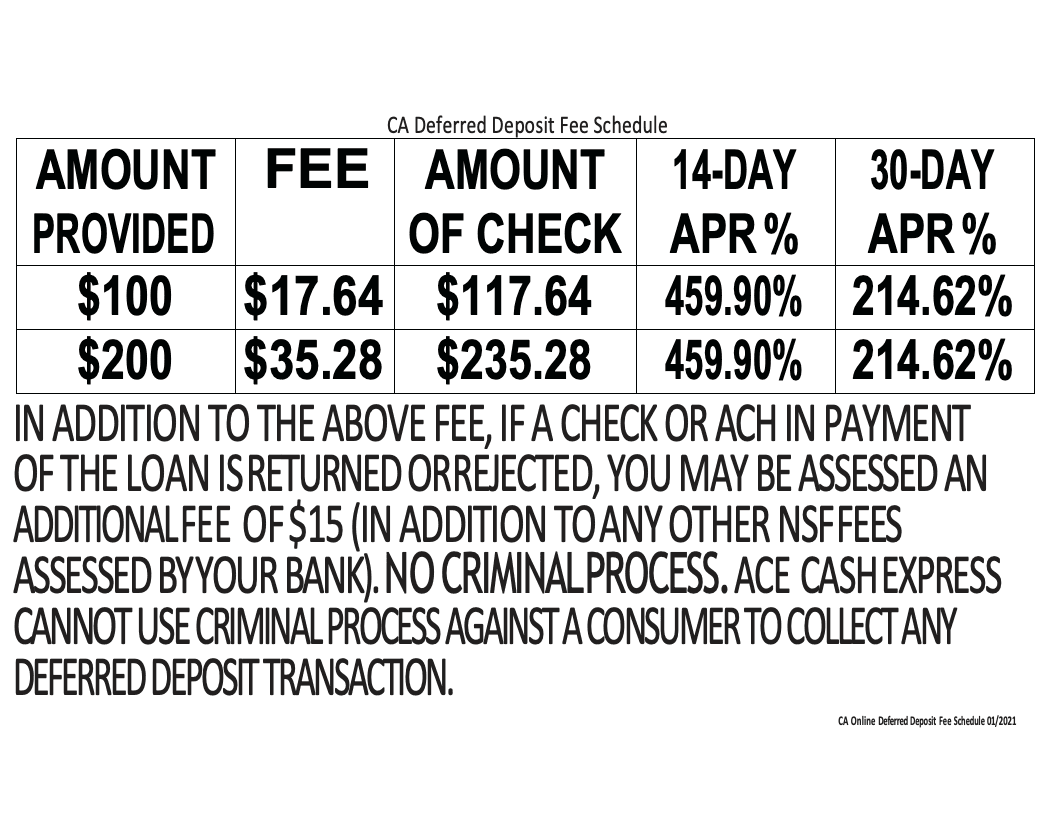
Source: ACE Cash Express fee schedule
Eligibility requirements:
You need to be 18 or older with valid government ID and Social Security number (or ITIN). A checking account (open and active) and proof of income (like a pay stub or benefits statement) are required. ACE will perform some credit and financial history check (often using alternative credit bureaus), but poor credit is not a barrier – "anyone can apply" and they focus on your ability to repay rather than FICO scores.
Application process:
Online or in-store. Online, you fill out a secure application on ACE's website. It's quick – many customers get an instant approval decision. If approved, you e-sign the loan agreement. ACE gives you multiple ways to get your cash: you can have it loaded to your debit card instantly, deposited to your bank account by the next business day, or pick up cash the same day at an ACE store. (You'll choose your preference during the application.)
Speed of funding:
Excellent. If you're approved online, ACE offers instant funding to a qualifying debit card (often within 30 minutes). Alternatively, they can do a same-day cash pickup in one of their 100+ California stores. Standard ACH deposit to your bank is usually next business day (if you complete the application by their daily cutoff). In short, you can often get your money within hours with ACE.
Reputation & customer feedback:
ACE Cash Express is a large, trusted name in payday lending. They are fully licensed and a member of industry trade associations. Customer reviews indicate a high level of satisfaction with the speed and convenience: on Trustpilot ACE is rated around 4.7 out of 5 stars (categorized as Excellent) based on over 10,000 reviews. Many Californians also use ACE's other services (like check cashing and money orders) and appreciate the one-stop shop. However, like all payday lenders, ACE has some complaints about costs – and indeed their loans are costly if not paid as agreed. Bottom line: ACE stands out for its instant funding options and long-standing presence. It's a strong option if you need cash urgently and want the ability to walk into a store for service or use a well-optimized online system.
Check 'n Go is a national payday loan and installment loan company that operates online in California (and has some partner store locations under the Allied Cash Advance name). They've been helping customers with short-term loans for over 20 years. In California, Check 'n Go offers online payday loans with straightforward terms.
Loan amounts & terms:
Up to $255 for California borrowers. The loan term is typically until your next paycheck (anywhere from about 2 to 4 weeks, but not beyond 31 days). You'll generally write a check or set up an ACH for the loan amount plus fee, dated to your payday.
Fees:
Check 'n Go charges the standard California fee: 15% of the face amount of the loan. For instance, borrowing $255 will incur a $45 fee. There are no hidden fees. If you cannot repay on time, by law they cannot charge extra interest for extending the time (though they may not offer an extension by default). The cost is high (roughly 460% APR for a 2-week loan), so make sure you understand the fee before proceeding.
Eligibility requirements:
Basic requirements include being at least 18, a resident of California, with a valid ID and Social Security number. You need an active checking account in your name and proof of income (such as recent pay stubs or benefit statements). Check 'n Go does not require good credit – they will verify some information but have no minimum credit score. In fact, they consider various income sources (employment, unemployment benefits, Social Security, etc.) as eligible income. You cannot have an outstanding payday loan elsewhere in California when applying.
Application process:
Online: You can complete the entire process on Check 'n Go's website. The application will ask for personal info, income details, and bank account info for funding/repayment. It's a quick process with an almost instant decision in many cases. If approved, you sign the loan agreement electronically. In-store: While Check 'n Go's own branded stores are limited in California, they partner with Allied Cash Advance centers in some cities. In-store applications can yield cash in hand immediately. Online approvals are typically funded by the next business day (via direct deposit to your bank). Note: You cannot pick up an online-approved loan in a store; online loans are funded via bank deposit.
Speed of funding:
Fast: If you apply online and are approved, Check 'n Go usually deposits the money by the following business day into your account. Some customers applying early in the day have reported same-day deposits, but generally expect next-day. If you go to a physical location (Allied Cash Advance), you can get cash on the spot during the visit. Either way, funding is quick – much quicker than a traditional bank loan.
Reputation & reviews:
Check 'n Go has a strong online reputation for customer service and ease of use. Trustpilot shows a 4.5/5 star rating based on nearly 10,000 customer reviews, indicating most users find the service reliable and convenient. Customers often mention the simple application and helpful staff. The company is also rated A+ by the BBB (though not accredited), reflecting that they respond to complaints. Some negative feedback exists, mainly about the high cost (which is inherent to payday loans) and aggressive collections if a loan goes unpaid. Overall, Check 'n Go is viewed as a credible and customer-friendly lender, making it a solid choice for a quick online payday loan in California.
Speedy Cash is a well-known payday loan lender with an extensive online presence and several store locations in California. True to its name, Speedy Cash focuses on getting cash to borrowers quickly – often with options for instant funding. They also offer other products (installment loans, lines of credit) in some states, but in California their offerings include the traditional payday loan.
Loan amounts & terms:
$100 to $255 for payday loans in California. The state cap applies, so first-time borrowers may be limited to a lower amount until they build a history. The loan term ranges from as short as 7 days up to 31 days, but most commonly it's aligned with your pay cycle (around 14 days for bi-weekly pay). Payment is due in full on that date.
Fees:
Speedy Cash charges the California-allowed fee of up to 15%. That means if you borrow $255, you owe $300 on payday (the $45 fee is 15% of $300). This is equivalent to very high APRs (hundreds of percent), typical of payday loans. They do not charge additional origination fees or monthly fees – just the one-time finance charge. Speedy Cash is transparent about the cost before you finalize the loan. (For perspective, one Speedy Cash customer on WalletHub noted the ~300%+ interest as "outrageous" – so only use these loans for short-term emergencies.)
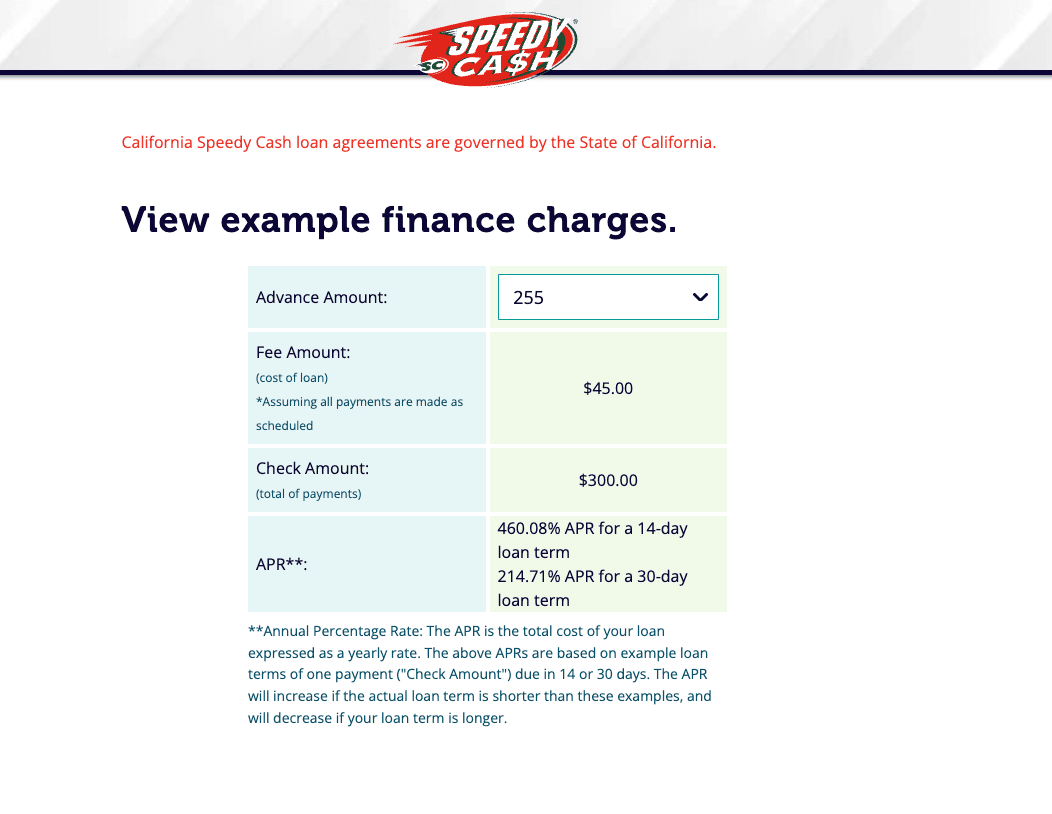
Source: Speedy Cash rates and terms
Eligibility requirements:
You must meet the standard criteria: 18+ years old, valid ID, Social Security Number, proof of income, and an active checking account. Speedy Cash is known for being lenient with credit – they state that borrowers with any credit history can be approved as long as you have the ability to repay. They may use alternative credit agencies to review your history, but there is no hard credit score cutoff. You cannot be in bankruptcy or have an outstanding Speedy Cash loan.
Application process:
Online: Speedy Cash has a user-friendly online application on their website or mobile app. It literally takes a few minutes to fill out. You can also apply by phone or in person at a Speedy Cash store. Approval is very fast – often within seconds or minutes of submission, you'll get a decision. Once approved, you review the loan terms and sign electronically. Speedy Cash stands out for its funding options: you can choose to receive money in as little as 10 minutes on a debit card or via an ACH transfer to your bank. If you opt for the debit card funding, you'll provide your debit card info – eligible Visa or Mastercard debit cards can be loaded almost immediately (typically within 30 minutes). ACH direct deposit usually arrives the same day or next business day depending on when you applied. If you applied in a store, you walk out with cash in hand.
Speed of funding:
One of the fastest. Speedy Cash is among the few lenders offering instant funding – customers who choose the debit card option often get funds within minutes after approval. For example, if you're approved at noon, you might have money on your debit card by 12:30 PM. ACH deposits, if approved early, can hit your bank account by that evening or the next morning. And of course, in-store loans give immediate cash. This speed is a major selling point for Speedy Cash.
Reputation & customer reviews:
Speedy Cash has a mixed but generally positive reputation. On Trustpilot, they hold about a 4.4/5 star rating with over 10,000 reviews, and ConsumerAffairs also shows ~4.5/5, indicating many users appreciate the fast and easy service. Customers frequently praise the quick approvals and that Speedy Cash will work with those who have bad credit. On the flip side, the company has a poor rating on the BBB and some other platforms (e.g., WalletHub ~1.6/5). Complaints include the high cost (which is inherent to payday loans) and some customer service issues or aggressive collections. It's worth noting that in 2018 Speedy Cash faced a class-action lawsuit alleging certain unlawful practices, but they continue to operate legitimately under state licenses. In summary, Speedy Cash is a legit and extremely fast option for payday loans – just remember to repay on time to avoid any troubles, as the costs will quickly add up if the loan is extended.
Moneytree is a regional payday lender that started in California and serves the West Coast. Founded in 1983, Moneytree operates multiple branch locations in California (as well as an online lending platform). They pride themselves on professional, friendly service – and many Californians are familiar with their retail locations. Moneytree offers payday loans with a transparent fee structure and a few unique features like high loan limits for repeat customers and instant funding options.
Loan amounts & terms:
Up to $255 for a payday loan in California. (Moneytree actually mentions loans "up to $255¹ with approval" – $255 being the cash disbursed, plus the fee makes $300 total.) First-time borrowers might not get the full $255; it depends on your income and their underwriting. The loan term is generally until your next payday, from a few days up to 31 days maximum. By law it cannot exceed 31 days. Moneytree also offers larger installment loans in California under a different license, but those are separate from the payday loan product.
Fees:
Moneytree charges approximately $17.65 per $100 borrowed on a 14-day payday loan. This is effectively the same as the 15% of face amount cap – for example, a $100 loan due in 14 days would cost $17.65 in fee, and you'd repay $117.65. Borrowing the maximum $255 costs $45 in fee (repay $300). They provide a fee schedule on their website so you know the exact dollar cost for any given loan amount. Importantly, if you cannot pay on time, Moneytree does not charge any additional interest or fees beyond that initial $45 max – you would just owe the $300 until it's paid (and possibly an NSF fee if your payment fails). Moneytree's fee is comparable to other lenders – extremely expensive in APR terms, but tightly regulated.
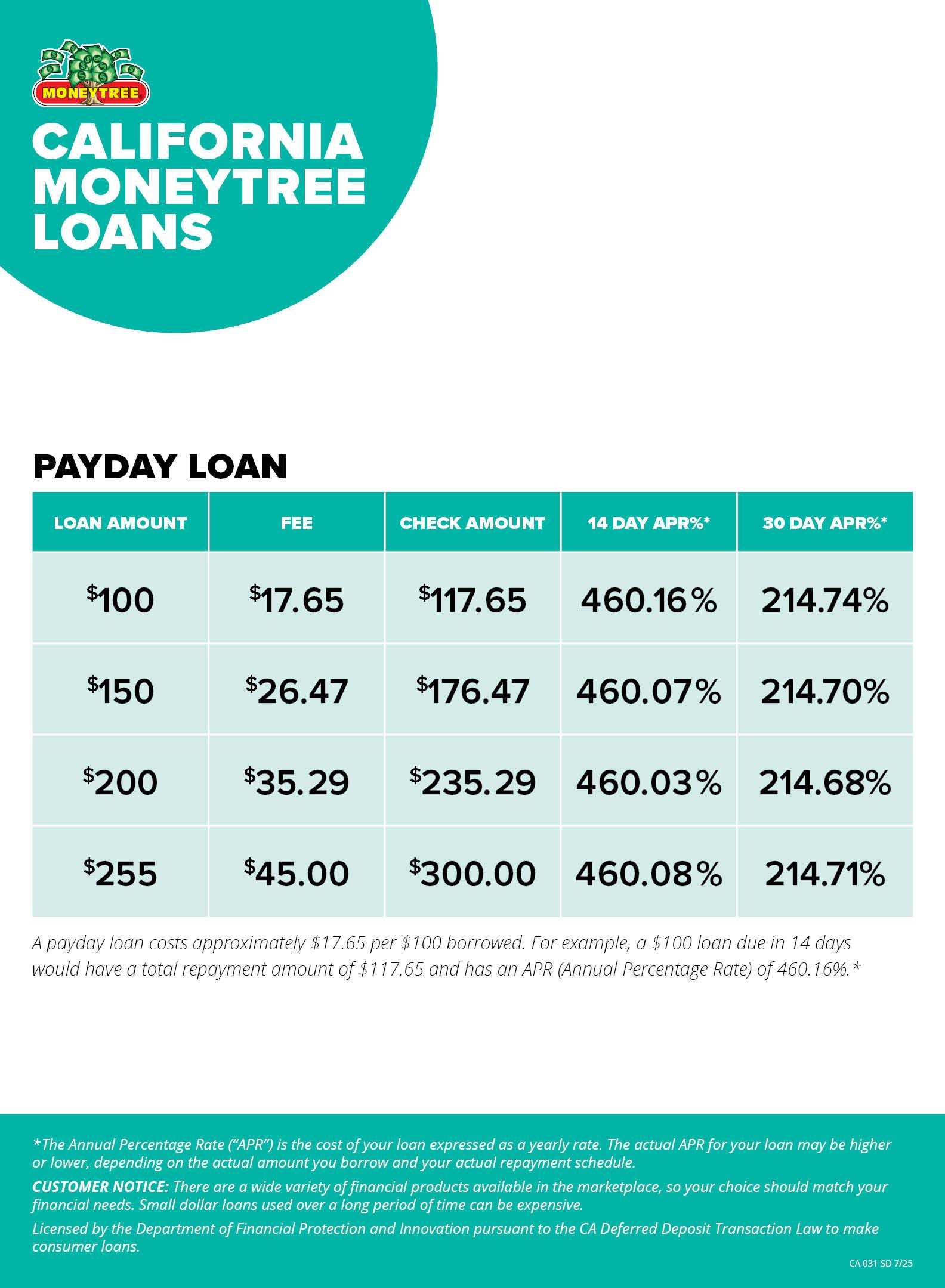
Source: Moneytree fee schedule
Eligibility requirements:
Standard requirements apply: 18 or older, government-issued ID, Social Security Number (or ITIN/Alien registration), and a verifiable source of income. You'll need to provide a proof of income (recent pay stub, etc.) and a working phone number and address. A checking account is usually required for payday loans (if applying online, definitely yes; in branch they may allow you to walk out with cash but you still need to provide a check or ACH authorization for repayment). Moneytree may approve loans with no traditional credit check – they state that they might check credit bureaus in some cases, but many borrowers are approved based on income and account status alone. They are licensed and follow California's rule of one loan at a time.
Application process:
In-Branch: You can walk into any Moneytree branch (they have dozens in CA) and apply with ID, proof of income, and a check. You'll typically receive cash on the spot if approved, and the whole process can take 15–20 minutes for new customers. Online: Moneytree's website allows California residents to apply online. The online application will verify your identity and income details (you may need to upload documents). Decisions are often quick – sometimes instant, other times a few minutes if manual review is needed. Once approved, you choose how to get the funds. Moneytree offers instant funding to your debit card in about 30–45 minutes, which is very fast. Alternatively, they can do an ACH bank deposit – but note this method is slower with Moneytree than some others, potentially taking 1 to 5 business days for the funds to appear depending on your bank. (The delay likely accounts for possible bank holds; often it will be 1-2 days in practice.) Lastly, you have the option to pick up cash at a Moneytree branch the same day – you could apply online and then go to a branch to get the cash immediately.
Speed of funding:
Same-day options available. If speed is critical, Moneytree's fastest method is to apply online and request Instant Funding to a debit card – you might have the money in under an hour. Or apply online and then visit a branch for immediate cash (during business hours). If you choose a normal bank deposit, be prepared that it might not be as instant; to be safe, expect maybe the next business day or two for ACH (they cite up to 5 days, but that's usually the worst-case scenario). Moneytree is unique in that they have both a robust online system and physical locations, giving borrowers flexibility in how to receive funds.
Reputation & customer experience:
Moneytree has a long history in California, often marketing themselves as a more personal, higher-quality service in the payday loan industry. They have earned customer loyalty at their branches for friendly service – many Yelp reviews praise individual tellers and the professional atmosphere (for example, offering free coffee at branches, etc.). Customer ratings: Moneytree's online presence shows a bit of a mixed picture. The company's Trustpilot profile is not very active (only a handful of reviews). On Yelp, however, Moneytree's average rating is ~3.8 out of 5 across many reviews. Many locations have 4 or 5 stars, while a few have lower scores – this suggests the experience can vary by branch. Common compliments are about courteous staff and quick help, while complaints sometimes cite billing/payment confusion or high costs. The BBB rates Moneytree A- (with some customer complaints noted). It's worth noting Moneytree was fined by the CFPB in 2016 for some debt collection practices, but they've since adjusted policies. As a licensed lender with decades in business, Moneytree is generally considered reliable and treats customers fairly, but do remember that the high cost and potential risks (as with any payday loan) are present. If you use Moneytree, take advantage of their clarity – know exactly what you must repay and have a plan to pay off the loan to avoid any long-term issues.
How we rate payday loan providers
Our ratings are designed to help readers compare payday loan providers using the same set of criteria. A higher rating does not guarantee that a lender is the right choice for every borrower.
Cost and fees
We review the lender’s advertised borrowing costs and whether its fees are clearly disclosed.
California availability and licensing
We check whether the provider offers the relevant product to California residents and review available state licensing information.
Transparency
We look at how clearly the lender explains loan amounts, repayment terms, fees, eligibility requirements, and important restrictions before a borrower applies.
Application experience
We consider how easy it is to understand and complete the application process, including whether online applications are available.
Funding and repayment information
We review how clearly the provider explains expected funding times, repayment methods, and what borrowers should expect after approval.
Customer experience
Where reliable information is available, we consider customer feedback and the accessibility of customer support.
Our editorial ratings are based on our review of publicly available information and are not a guarantee of approval, pricing, or customer experience. Loan availability and terms can change, so borrowers should verify current terms directly with the provider before applying.
Conclusion: making an informed decision
Payday loans in California can provide quick access to cash, but they are expensive and should be used carefully. State law limits loan amounts and fees and prohibits rollovers, yet a $255 loan can still cost about $45 in fees.
Before borrowing, consider alternatives such as payment extensions, help from friends or family, credit union loans, or lower-cost installment loans. Our emergency loans guide covers options from $100 to $10,000+, including eligibility, funding times, and repayment costs.
If you decide to use a payday loan, choose a licensed lender, compare terms, and borrow only what you can repay on time. Read the loan agreement carefully and make sure you understand the fees, repayment date, and withdrawal terms.
Payday loans may help in a short-term emergency, but repeated borrowing can lead to a cycle of debt. Understanding California law and the lender's terms can help you make a safer, more informed decision.
Sources
Primary references used to review this article: