OnlineLoans.org is a comparison marketplace, not a lender. We may earn compensation from partners featured on this site, which can affect placement. Editorial content is informational and is not financial, legal, or professional advice.
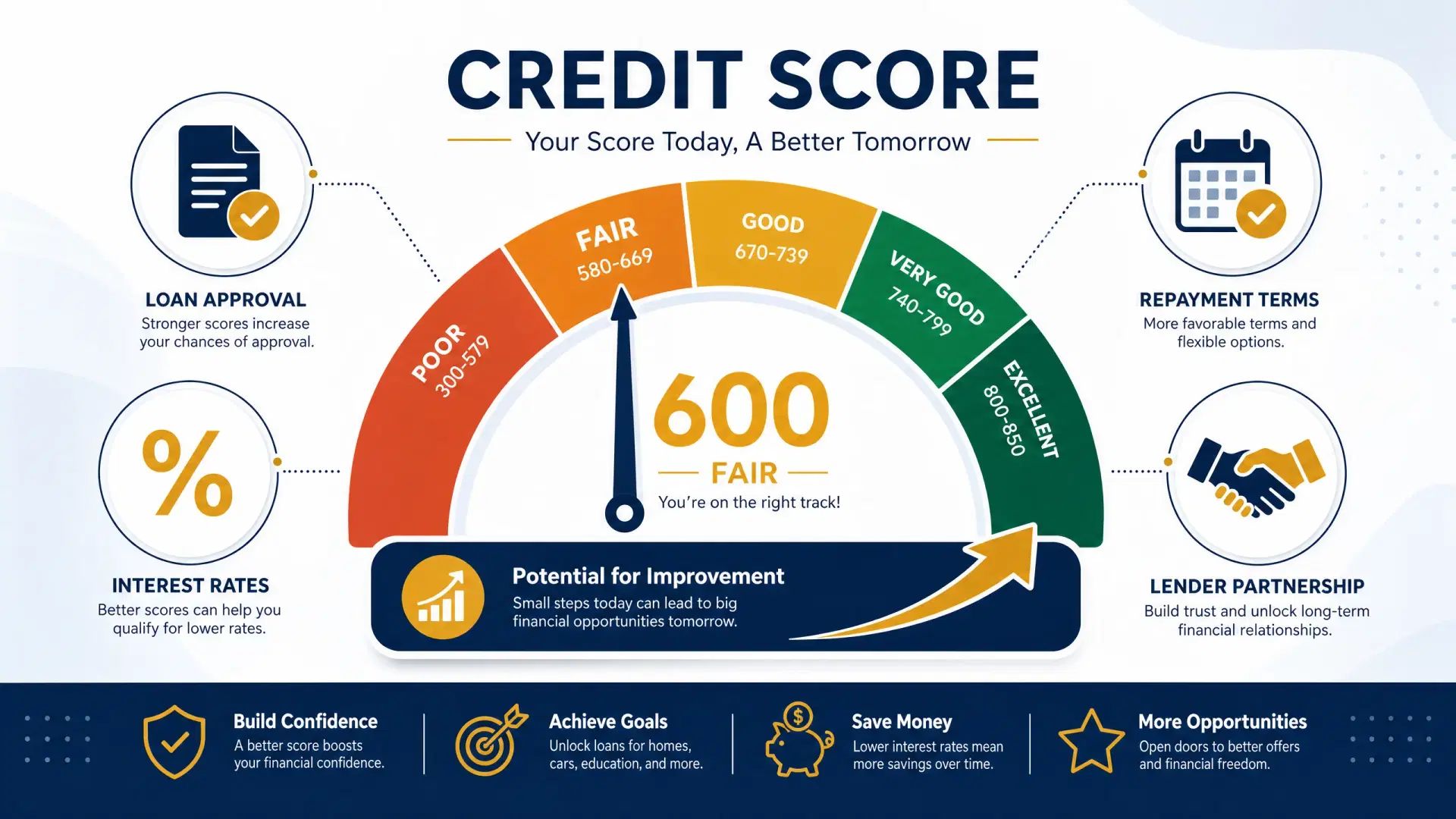
A 600 credit score personal loan is an unsecured installment loan available to borrowers with a "Fair" FICO score or VantageScore — typically defined as a score between 580 and 669. Borrowers in this fair credit range are not disqualified from personal loans, but they face higher interest rates (APRs) and stricter income verification requirements than borrowers with good or excellent credit (670+). According to FICO's scoring model, approximately 17% of U.S. consumers fall in the Fair credit range, making this a common borrowing tier.
Your Credit Score Position
Poor 300Fair 580Good 670Very Good 740Exceptional 800
"Only about 50% of Americans are considered prime credit based on their credit scores and traditional credit reports... there is a whole another third of the country that would have been able to pay you back, but you would erroneously disqualify."
— Dave Girouard, Co-founder & CEO, Upstart
Approval
Can you get a personal loan with a 600 credit score?
Yes. A 600 credit score qualifies for personal loans from multiple online lenders and credit unions. While traditional banks typically require a minimum score of 660–700, online lenders such as Upstart, Avant, and LendingPoint specifically serve fair-credit borrowers and accept scores as low as 550–600.
"Our goal is to create a new financial ecosystem where customers can access the resources they need for every step in their financial journey."
— Tom Burnside, CEO, LendingPoint
The key factors lenders evaluate beyond your credit score include:
Debt-to-income (DTI) ratio — most lenders prefer a DTI below 36–40%, which compares your monthly debt payments to your gross monthly income.
Stable, verifiable income — recent pay stubs, W-2s, or tax returns prove your ability to repay.
Employment history — consistent employment signals lower repayment risk to underwriting algorithms.
Existing debt obligations — fewer open credit accounts with low balances (low credit utilization) improve your approval odds.
Rates & Terms
What to expect: rates, terms, and loan amounts
Borrowers with a 600 credit score should expect the following loan terms based on current market data:
Loan Feature
Typical Range for 600 Credit Score
APR (Annual Percentage Rate)
15.00% – 35.99%
Loan Amount
$1,000 – $35,000
Repayment Term
24 – 60 months
Origination Fee
1% – 10% of loan amount
Funding Speed
1 – 5 business days
💡
Watch out for origination fees — they are deducted directly from your loan proceeds before funding. A $10,000 loan with a 5% origination fee means you receive $9,500.
"A personal loan is a unique borrowing tool because it offers structure, predictability, and versatility all in one product... Personal loans can be useful in the right circumstances, but they are not a one-size-fits-all solution."
— David Kimball, Chairman & CEO, Prosper
Lender Comparison
Top lenders for a 600 credit score in 2026
Several online lenders cater specifically to borrowers with fair credit. The following lenders accept scores around 600 and offer transparent pre-qualification with no hard credit pull:
Upstart
APR Range
6.20–35.99%
No minimum score
Uses AI + education & employment data
Avant
APR Range
9.95–35.99%
Min score: 550
Fast funding — next business day
LendingPoint
APR Range
9.99–35.99%
Min score: 620
Strong income can offset lower score
Prosper
APR Range
8.99–35.99%
Min score: 560
Joint applications; peer-to-peer model
✅
Pro tip: Pre-qualifying with 3–4 lenders takes under 10 minutes and uses only soft credit pulls — no score impact. Always compare the full APR, not just the monthly payment.
Pull your free reports from Equifax, Experian, and TransUnion at AnnualCreditReport.com. The FTC reports 1 in 5 consumers has an error. Disputing inaccuracies can raise your score within 30–45 days.
2
Gather your income documents
Prepare recent pay stubs (last 30 days), two most recent W-2s or tax returns, and bank statements showing consistent deposits.
3
Pre-qualify with multiple lenders
Soft-pull pre-qualification (also known as checking your rate) shows your estimated rate and amount without affecting your score. Compare at least three offers, focusing on the full APR.
4
Consider a co-signer
A co-signer with a 700+ score can improve approval odds and reduce your APR by 5–10 percentage points. The co-signer becomes equally responsible for repayment.
5
Submit your application and accept the best offer
The lender performs a hard inquiry (−2 to −5 points, temporary). Funds arrive in 1–5 business days after approval.
Credit Tiers
How a 600 credit score compares
Understanding where a 600 score sits relative to other tiers helps set realistic expectations:
Alternatives to personal loans with a 600 credit score
If personal loan rates are too high, consider these alternatives:
Credit union loans — Credit unions are member-owned nonprofits that often offer lower rates than online lenders for fair-credit borrowers. The National Credit Union Administration (NCUA) caps interest rates at 18% APR for most credit union loans, significantly below the 35.99% ceiling at online lenders.
Secured personal loans — By pledging collateral (a savings account, CD, or vehicle), you can often qualify for lower rates even with a 600 score. The lender's risk is reduced, so approval is easier and APRs are lower.
Credit builder loans — Offered by credit unions and community banks, these small loans (typically $300–$1,000) are designed specifically to build credit. Payments are reported to all three bureaus, and you receive the funds at the end of the loan term.
FAQ
Frequently asked questions
Summary
Key takeaways
A 600 credit score qualifies for personal loans from multiple online lenders, though rates will be higher than for borrowers with good or excellent credit. The most important steps are to pre-qualify with multiple lenders (no credit impact), compare the full APR including origination fees, and consider a co-signer if your initial offers are too expensive.
If your goal is to lower your borrowing costs long-term, focus on improving your credit score toward the 670 threshold — even a 50-point improvement can meaningfully reduce your APR and expand your lender options. Paying bills on time, reducing credit card balances below 30% utilization, and disputing credit report errors are the three fastest ways to move the needle.
This article is for informational purposes only and does not constitute financial advice. Loan terms and lender policies are subject to change. Always verify current rates directly with lenders before applying. Last updated: May 2026.